Severe thunderstorms, squall lines, and tropical systems regularly test the structural integrity of mature trees across Northwest Houston. Dense canopies, saturated clay soils, and unaddressed structural defects make large oaks and pines particularly vulnerable to failure during high winds. Preparing your mature trees ahead of storm season protects both your property and the long-term health of your landscape.
Soil Saturation and Root Plate Stability
In areas like Tomball, Cypress, and Spring, heavy rainfall quickly saturates the region's dense clay soils. When soil becomes waterlogged, root plates lose their mechanical grip on the earth, significantly increasing the likelihood of whole-tree failure during sustained wind events.
Mature loblolly pines and spreading water oaks are especially prone to uprooting when high winds hit ground that is already soaked. Checking the soil around the root flare for settling, cracking, or mounding after heavy rains is critical for identifying unstable root systems early.
Warning Signs of Canopy and Trunk Failure
- Co-dominant stems with included bark, which form weak V-shaped unions prone to tearing apart in high winds.
- Dead, dying, or hanging limbs in the upper canopy that can drop onto roofs or power lines.
- Fungal conks, mushrooms, or carpenter ant activity near the root flare, signaling internal wood decay.
- Cavities or hollows along the trunk that compromise the tree's structural strength.
Pruning to Reduce the Sail Effect
Storm preparation does not mean severely topping a tree or stripping the inner branches, known as lion-tailing. Topping leaves large wounds that invite decay and prompts weak, fast-growing sprouts that break easily in future storms.
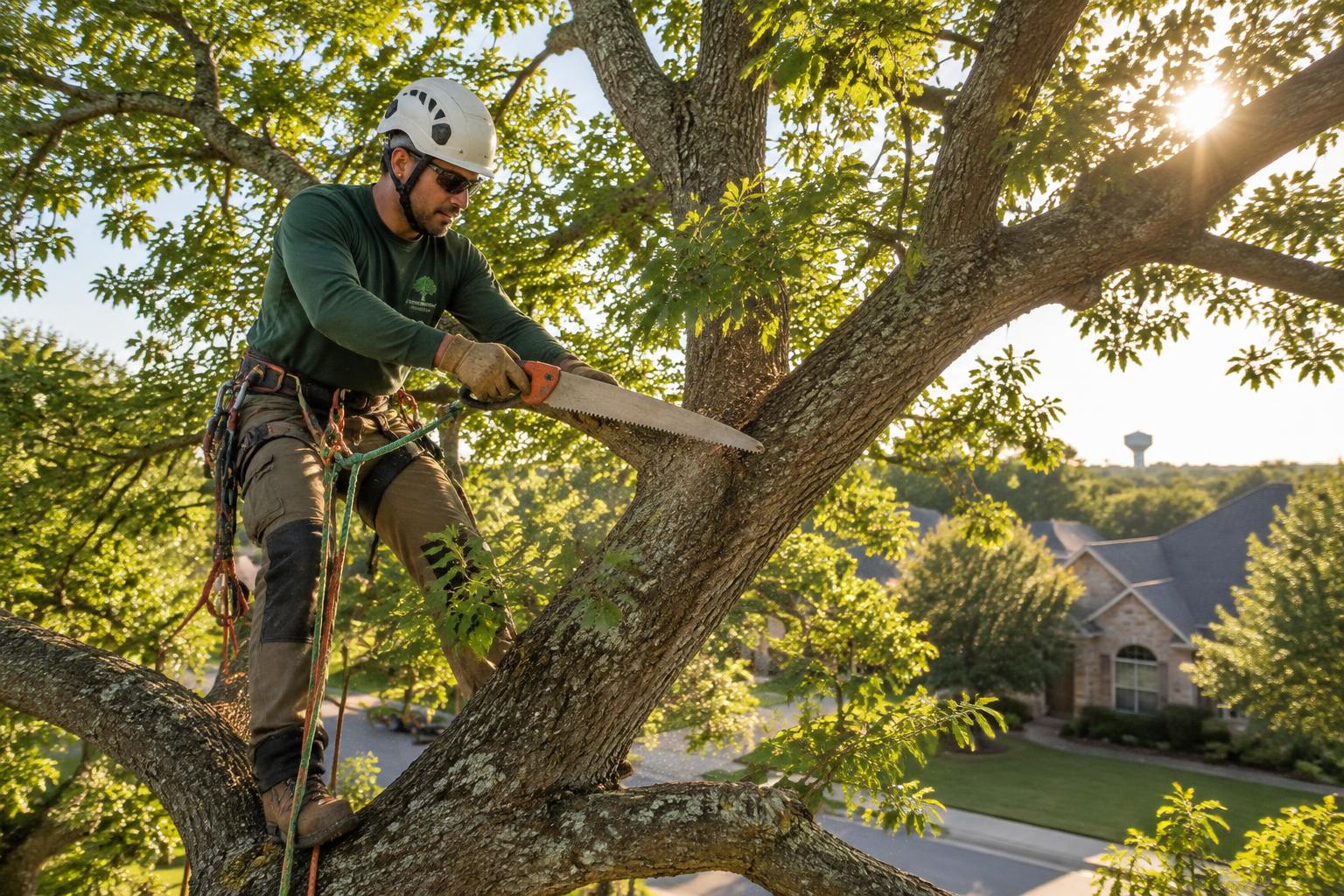
Professional crown thinning selectively removes deadwood and strategically thins outer branches. This technique reduces the canopy's wind resistance—the sail effect—allowing storm winds to pass through the canopy without applying excessive force to the trunk and root plate.
Supplemental Support: Cabling and Bracing
For mature, high-value trees with structural flaws that cannot be corrected by pruning alone, supplemental support systems offer an effective solution. Arborists can install high-strength steel or synthetic cables high in the canopy to limit branch movement during turbulent winds.
Through-rods can also be placed through split or weak crotches to hold large stems together. When installed to ANSI A300 standards, these systems allow property owners in Magnolia and The Woodlands to preserve mature shade trees safely.
Steps for Proactive Storm Preparation
- Schedule an inspection with a TCIA-certified arborist before hurricane season begins.
- Identify and address branches encroaching on utility drops, rooflines, and outbuildings.
- Clear drainage swales near mature root zones to prevent prolonged water ponding around the base.
- Avoid heavy construction or trenching within the critical root zone that could undermine stability.
Want a Specialist to Take a Look?
Book a free consultation with our TCIA Certified Tree Care Specialists and save 10% on this month's service.