Northwest Houston summers regularly bring consecutive weeks of triple-digit heat and minimal rainfall. While established trees have expansive root systems, prolonged drought eventually exhausts subsoil moisture, leading to premature leaf drop and canopy dieback. Knowing how and where to apply water ensures your mature trees survive the summer intact.
Why Lawn Sprinklers Are Not Enough
Most automatic sprinkler systems run for 15 to 20 minutes per zone, delivering just enough moisture to keep turfgrass green. This shallow watering only penetrates the top two or three inches of soil, which quickly evaporates under the harsh Texas sun.
Established trees have root systems extending 12 to 18 inches deep, where fine absorbing roots take up moisture. To reach this depth in Northwest Houston's dense clay soils, water must be applied slowly and over several hours rather than in brief, high-volume bursts.
Focusing on the Dripline, Not the Trunk
The most common watering mistake is placing a hose directly against the base of the trunk. Mature trees absorb very little water at the root flare, and saturating the bark creates favorable conditions for fungal rot and collar rot.
Instead, focus water across the tree's dripline—the perimeter directly beneath the outermost tips of the branches. This zone contains the highest concentration of active feeder roots capable of drawing moisture up into the canopy.
Effective Methods for Deep Summer Watering
- Lay a soaker hose in concentric rings around the dripline and run it on low pressure for three to four hours.
- Set an open garden hose to a slow, pencil-thick trickle and move it around the canopy edge every 45 to 60 minutes.
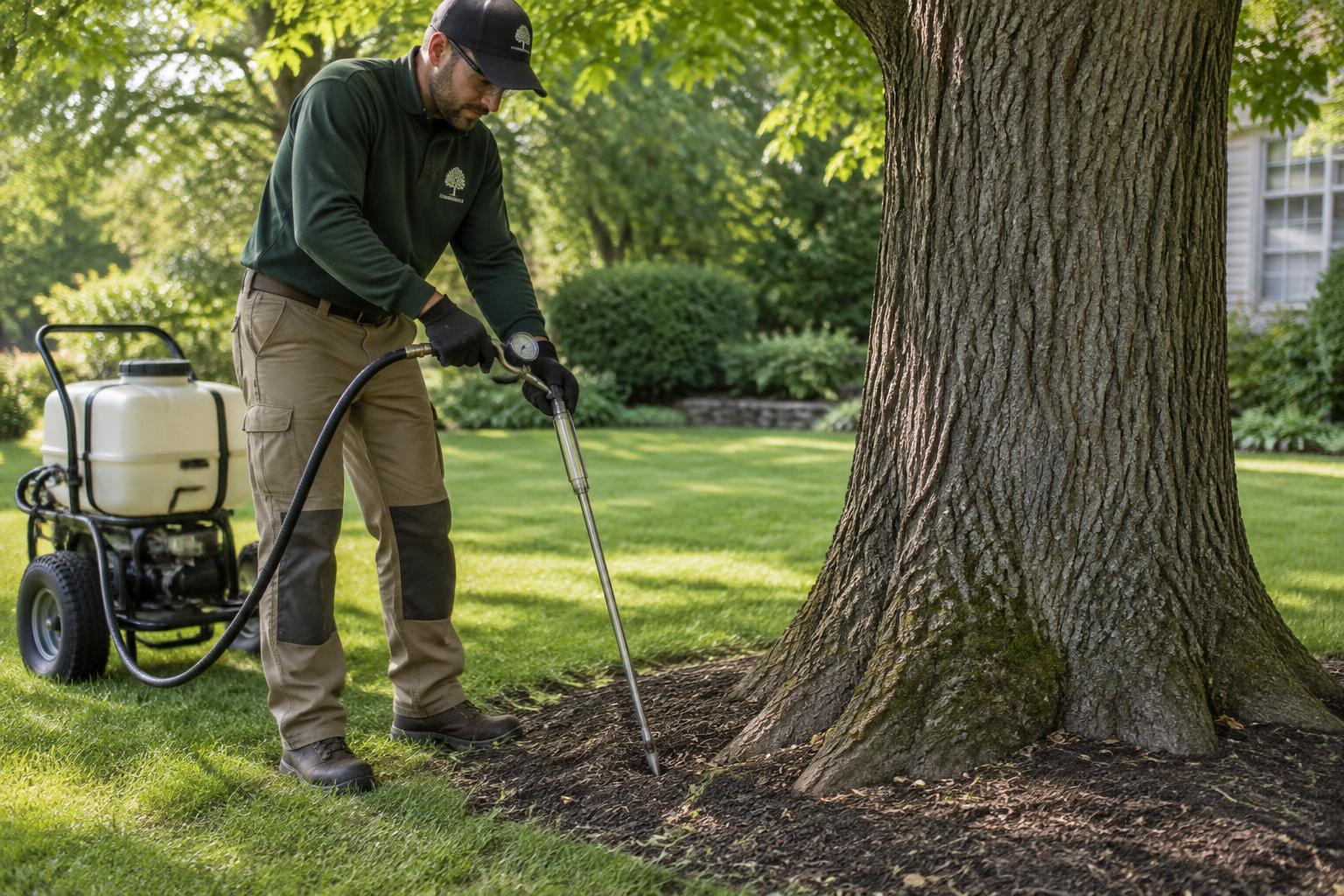
- Use a deep-root watering probe inserted no deeper than 8 to 10 inches to avoid damaging larger structural roots.
- Apply water during early morning or late evening hours to minimize loss from surface evaporation.
Evaluating Moisture in Northwest Houston Clay
Clay soil in areas like Tomball, Cypress, and Magnolia retains moisture longer than sandy loam, but it can also form a hard, cracked crust that repels water when completely dry. Before watering, push a long screwdriver or soil probe into the ground beneath the canopy.
If the probe slides easily six to eight inches into the soil, moisture levels are adequate and watering can wait. If the tool meets hard, dry resistance within the first two inches, it is time for a deep soaking cycle.
Common Symptoms of Heat and Drought Stress
- Scorched, browned leaf margins on outer branches exposed to direct afternoon sun.
- Early yellowing and unseasonal leaf shedding, particularly on interior canopy limbs.
- Wilting leaves that fail to recover their turgidity by the following morning.
- Fine canopy thinning, which leaves upper branches looking sparse and exposed.
Want a Specialist to Take a Look?
Book a free consultation with our TCIA Certified Tree Care Specialists and save 10% on this month's service.